What does gondola mean in Italian?
In Italian the word only names the boat, and its origin has never been settled. The candidate roots, the eight woods, the ferro decoded, and why they are black.
 By Marco Zanetti, Venice gondola ride specialist & canal experience guide
Short Answer
Gondola is the Italian name for Venice’s characteristic rowing boat. Its linguistic origin is disputed; the construction and rowing technique are separate parts of the boat’s story you can explore in person.
Ask an Italian what gondola means and you will get a puzzled look, because it does not mean anything. It names a boat, the way canoe names a boat. No hidden poetry, no root that translates to swaying or to love, whatever the plaque outside the souvenir shop says. What makes the word interesting is that the reference works still cannot tell you where it came from.
The boat is a different matter. Every part of it carries meaning that is documented and specific, from the six teeth on the bow to the reason it is black.
Price and review comparisons below use the site’s August 2026 snapshot. Online quotes depend on the date, party and option; compare the final total and current inclusions before paying.
Booking choice: See a restoration workshop and traditional wooden boats before trying the rowing technique that drives them. Check the Ride Options ↗
What does the word gondola mean in Italian?
Almost nothing beyond the object. In Italian, gondola names the Venetian lagoon boat, listed in the dictionary as a black flat-bottomed vessel driven by a single stern oar. It carries a second technical sense in aviation, where it means a nacelle, and survives in the phrase "a gondola" describing a curved shape.
That second sense is the one nobody expects. In Italian aeronautical vocabulary, gondola means a fuselage or a nacelle: the pod slung under an aircraft or an airship. The logic is visual. A nacelle is a long tapered hull hanging in space, so it took the name of the hull Italians already had a word for.
The word also throws off a diminutive, gondoletta, and an adjectival phrase. Describe something as shaped "a gondola" and you mean it curves inward with raised ends, like the boat in profile. There is no verb and no figurative use about romance.
Where does the word come from?
Nobody has established it. The reference works are unusually blunt: the origin of the word gondola has never been satisfactorily settled, despite many theories. The two candidates that survive scrutiny are medieval Greek kondoura, a type of boat, and Latin cymbula, a small skiff. Neither is confirmed.
Venice traded with Byzantium for centuries, so a Greek borrowing is plausible, and the Italian dictionary of record hedges towards it, listing the headword as a Venetian term possibly from kondoura. The Latin route runs through cymbula, a small boat, the version guidebooks repeat as settled fact. It is not settled fact. English etymological dictionaries trace the word back only as far as Old Italian gondula and then stop, marking it of unknown origin.
| Candidate root | Language | Meaning | Standing |
|---|---|---|---|
| kondoura | Medieval Greek | A type of boat | Favoured by the Italian dictionary of record, marked as possible |
| cymbula | Latin | Small boat or skiff | The most-repeated version, still unproven |
| gondula | Old Italian | Not established | Earliest attested form, origin unknown |
You will also find claims tying the word to dondolare, to sway, or to conca, a basin. Those read as folk etymology working backwards from the boat's motion, and no serious source supports them. The encyclopedic account of the boat says only that the question remains open, which is the correct answer to give.
What is a gondola actually made of?
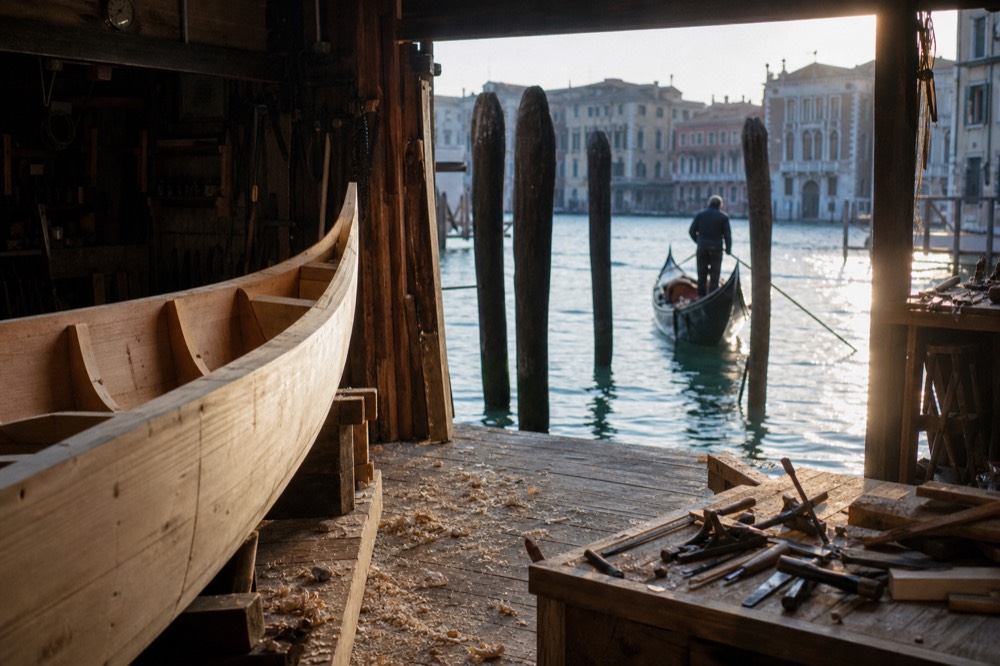
Eight kinds of wood, about 280 separate pieces, and roughly 400 kg of finished boat. Oak, fir, cherry, larch, walnut, lime, mahogany and elm each go where their properties suit, and a new gondola costs in the region of €40,000. It is built by hand in a squero, a traditional boatyard, over months.
The build justifies the price of a ride more than anything a listing will tell you. Each wood does a job: the flexible ones bend into the hull's curve, the hard ones take the wear. The hull is asymmetric on purpose, one side shaped differently so a single stern oar drives the boat forward instead of turning it. Published dimensions vary, because no two are identical.
| Feature | Figure | Note |
|---|---|---|
| Woods used | 8 | Oak, fir, cherry, larch, walnut, lime, mahogany, elm |
| Component pieces | About 280 | All shaped and fitted by hand |
| Finished weight | About 400 kg | Before any passengers |
| Length | About 11 m | Long relative to its beam |
| Beam | About 1.42 m | Narrow enough that two adults fill the bench |
| Extension beyond the standard ride | Priced proportionally to time | Agree duration and total before boarding |
A handful of squeri still work in Venice. The best known, Squero di San Trovaso in Dorsoduro, builds new gondolas at roughly one a year alongside repairs, using a permanent wooden form and a master craftsman rather than a plan on paper. One boat a year tells you something the visitor numbers do not: this is a craft sustained by maintenance, not expansion.
What does the metal comb on the bow mean?
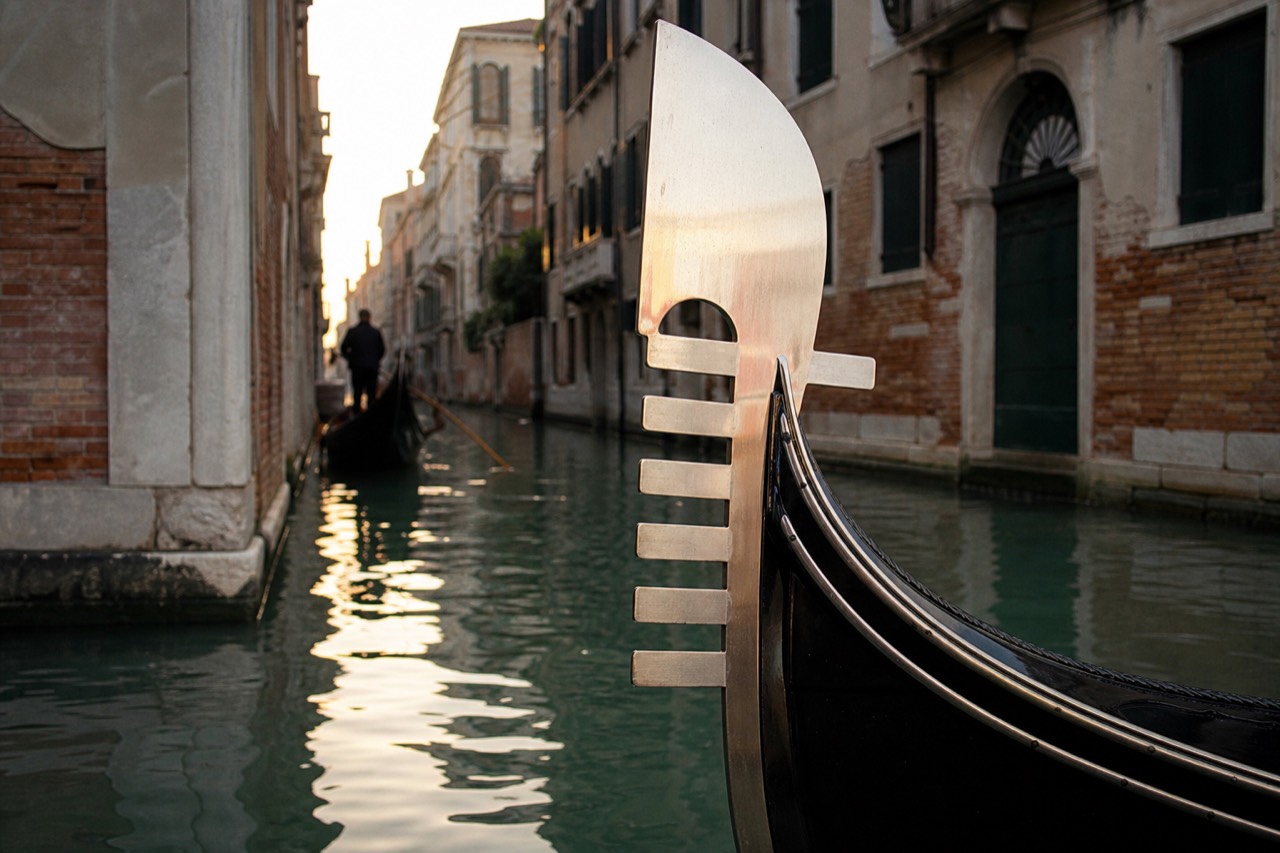
The ferro, the iron blade on the prow, is a map of Venice. Its S-curve traces the bends of the Grand Canal, the six forward teeth stand for the six sestieri, the tooth pointing backwards is Giudecca, and the curved top echoes the Doge's hat. It also works as a counterweight.
This is the piece everyone photographs and nobody can read. Once you know the code you cannot unsee it: the whole design is a city rendered in metal.
| Element of the ferro | What it stands for |
|---|---|
| The S-curve of the blade | The course of the Grand Canal |
| Six forward-facing teeth | The six sestieri, the city's districts |
| One rearward tooth | Giudecca, across the water |
| Curved crest on top | The corno, the Doge's hat |
| Semicircular break between teeth | Commonly read as the Rialto Bridge |
| The mass of it | Counterweight balancing the gondolier at the stern |
One caveat: this reading is standard and consistently reported, but not ancient scripture. Older paintings show ferri with four or five teeth rather than six, so the tidy symbolism appears to have been settled later than the object. The counterweight function is pure physics and always was. For the landmarks rather than the ironwork, what you float past on the Grand Canal walks the water palazzo by palazzo.
Why are all the gondolas black?
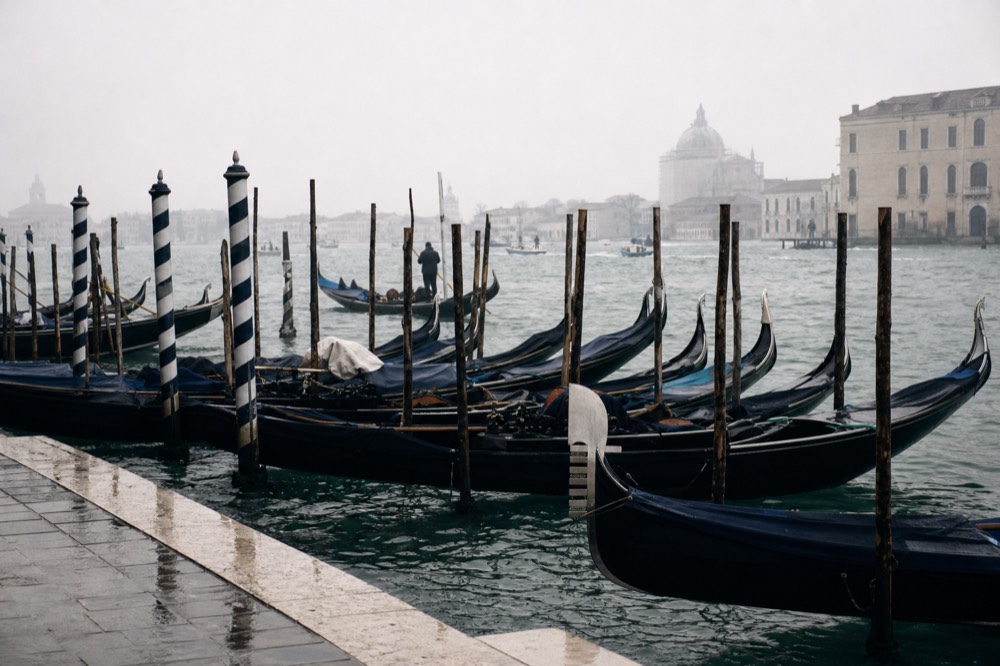
A sumptuary law of 1562. Venetian nobles had been competing through increasingly ornate and expensive boats, so the city legislated the display away and required public gondolas to be painted black. The rule outlived the republic that made it, and the fleet has stayed black ever since.
Sumptuary laws were the anti-luxury regulations of the age, and Venice passed a great many. This one worked, in the sense that a restriction on showing off became the most recognisable object in Italy.
The fleet behind it has collapsed and stabilised. Around 400 gondolas work the canals today, most carrying visitors. At the sixteenth-century peak the city counted close to 10,000, in a Venice of perhaps 100,000 to 150,000 residents, when this was simply how people moved. The lagoon itself, listed by UNESCO as a world heritage site, is why the boat exists in this form: shallow sheltered water rewards a long flat hull that draws almost nothing.
Whether the modern ride justifies its price is a separate argument, and the honest verdict from the reviews makes the case both ways. The shared gondola rides start at $43 a seat, the ranked comparison of every ride sorts them by rating, and the combined tours with a guided walk pair the water with St. Mark's and the Doge's Palace. For a package of about an hour, including a roughly 30-minute gondola ride plus an introduction and gallery visit, you can check live prices and dates. The people rowing have their own history, in whether women row these boats.
Common questions about the word and the boat
Does gondola mean anything romantic in Italian?
No. The word names the boat and carries no figurative or affectionate sense in Italian. Claims that it derives from a root meaning to sway or to rock are folk etymology, working backwards from the motion of the boat rather than from any documented source.
Why is the gondola's hull lopsided?
Because it is rowed by one person with one oar from the stern, which pushes the boat sideways as well as forwards. Building one side with a different curve counteracts that push, so the gondolier holds a straight line without constantly correcting. Deliberate asymmetry, not a defect.
Your next step
Check Your Date Before Planning the Rest
Gondola Ride and Gondola Gallery
Discover the boat’s history with an introduction and gallery visit, plus about 30 minutes in a shared gondola.
About 60 minutes overall, not 60 minutes on the water. Meeting point and gallery access depend on the option. No hotel pickup.
Choose a date to see scheduled departures. Availability and final price are confirmed on Viator.
Choose How to Explore the Boat’s History and Compare Costs
What Changes Between Options?
- Gondola Ride and Gondola Gallery: Discover the boat’s history with an introduction and gallery visit, plus about 30 minutes in a shared gondola. About 60 minutes overall, not 60 minutes on the water. Meeting point and gallery access depend on the option. No hotel pickup.
- Learn to Row in Venice: Try standing Venetian rowing with a local instructor, starting at a Cannaregio boatyard. A traditional Venetian boat, not a private gondola rental or professional qualification. Maximum six; age bands start at three. Not wheelchair accessible.
Booking through these links may earn us a commission at no extra cost to you.