Can a woman be a gondolier?
Yes, and one woman has been licensed since around 2010. The exam, the 400 training hours, the closed guild, and why only three or four licences open a year.
 By Marco Zanetti, Venice gondola ride specialist & canal experience guide
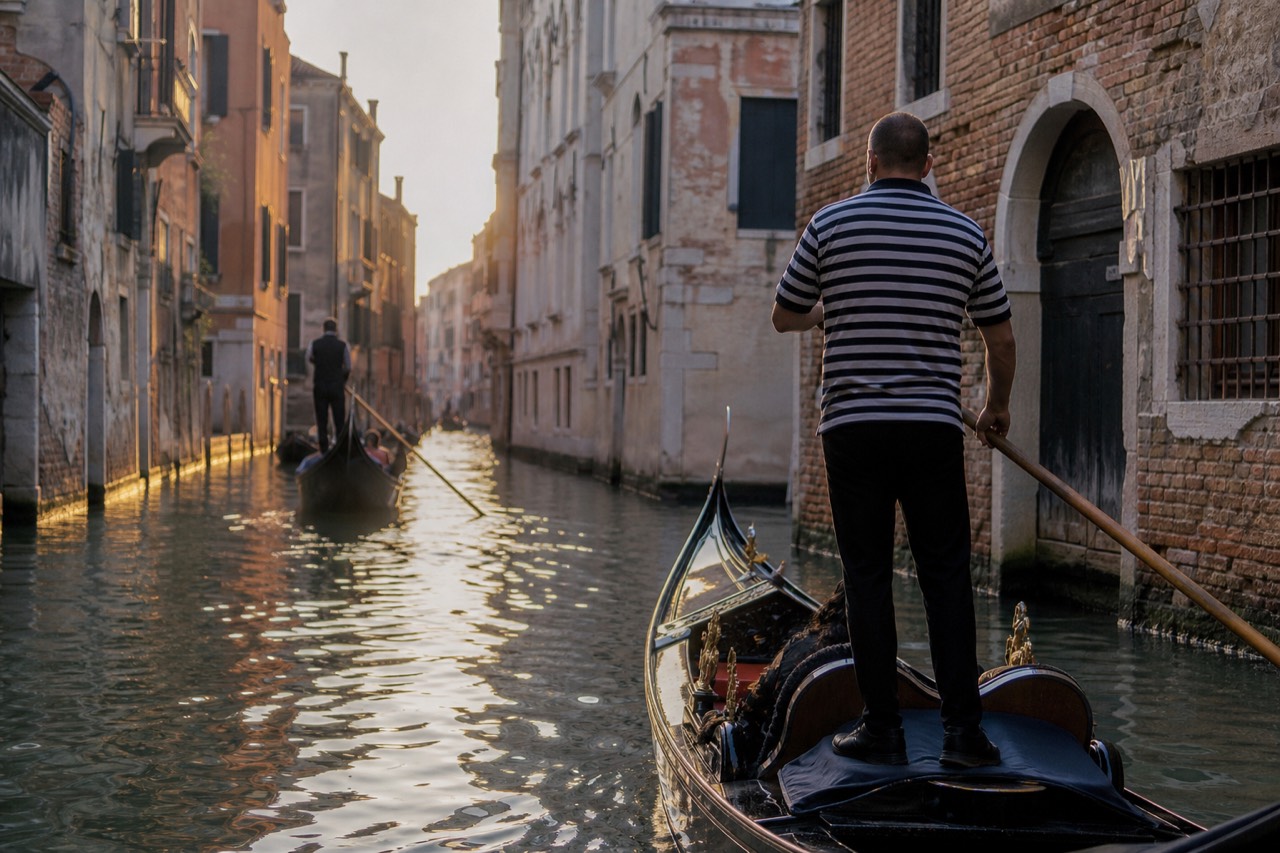
Short Answer
Yes, women can be licensed gondoliers. A visitor rowing lesson lets you try the skill, but it is not a professional qualification and does not guarantee a female instructor.
For as far back as the trade keeps records, every person licensed to row a gondola for hire in Venice was a man. Then in 2009 a woman who had grown up in a gondolier's household sat the same exam as everyone else and passed it. Giorgia Boscolo took her licence around 2010, trained by her father, and the story went around the world under headlines about a broken tradition.
What is less often reported is what happened next, which is close to nothing. The answer to the question is yes, unambiguously. The reason you will almost never see it on the water is a licence system, not a rule about women.
Price and review comparisons below use the site’s August 2026 snapshot. Online quotes depend on the date, party and option; compare the final total and current inclusions before paying.
Booking choice: Try the standing rowing skill with a local instructor at a Cannaregio boatyard. This is a visitor lesson, not professional licensing. Check the Ride Options ↗
Can a woman be a gondolier in Venice?
Yes. No regulation has ever barred women from the profession. Giorgia Boscolo became the first officially licensed female gondolier around 2009 to 2010, passing the same examination as male candidates after training under her father. The Italian feminine form, gondoliera, entered general use through the coverage of her licensing.
The distinction that matters here is between a prohibition and a bottleneck. There was no law saying women could not row. What existed instead was a closed profession where licences pass within families, training happens through apprenticeship to someone who already holds one, and the total number is capped by the gondoliers' own institution. If almost every licence holder is a man and almost every apprentice is his son, the outcome looks like a ban without anybody having to write one.
Boscolo's route through it is instructive precisely because it was the normal route. She was a gondolier's daughter. She trained the way a gondolier's son would have trained. The reporting on her career has returned to that point repeatedly: the door was opened by family, the same as it is for everyone else who gets in.
How many female gondoliers are there now?
Not a settled number, and anyone quoting one confidently is overreaching. Sources through the 2010s and 2020s describe Boscolo as the only, or the principal, licensed woman in the trade. A 2024 report claims as many as 14 women hold licences today, but that figure is not corroborated elsewhere, and no newer named licensees appear in current sources.
We would rather leave that unresolved than tidy it into a number. What the current record supports is this: one woman is confirmed and named, the profession remains overwhelmingly male, and the higher figures circulating online rest on a single uncorroborated claim. Nothing in the searches we ran through mid-2026 turned up additional named licence holders or a change to the process.
One reason the count is so hard to pin down: the guild publishes no live register, and even the total number of licences is reported differently from source to source, anywhere from about 400 to 433. When the denominator is that fuzzy, the numerator will be too.
How do you become a gondolier?
Around 400 hours of training, then an examination set by the gondoliers' institution, then an apprenticeship of roughly six to twelve months, then a practical test that includes handling the boat in real canal traffic or at high water. The syllabus covers Venetian history, landmarks, foreign languages and navigation, not just rowing.
The language requirement surprises people. A licensed gondolier is expected to work with visitors from anywhere, which makes the job closer to a guide's than a ferryman's, and the theoretical half of the training reflects that. The practical half is harder than it looks from the bench. A gondola is about 11 metres long and 1.42 metres across, deliberately asymmetric so a single stern oar drives it straight, and the exam puts a candidate into moving traffic with vaporetti and water taxis throwing wash across the channel.
| Stage | What it involves | Typical length |
|---|---|---|
| Training course | History, landmarks, languages, navigation, rowing technique | About 400 hours |
| Examination | Set and administered by the gondoliers' institution | One assessment |
| Apprenticeship | Working under a licensed gondolier | Roughly 6 to 12 months |
| Practical test | Handling in canal traffic or at high tide | Final gate |
| Licence | Issued only against available places | Capped, 3 to 4 a year |
That last row is the whole story. Passing does not entitle you to a licence, because the number of licences is fixed. Candidates wait for one to become free.
Why are there so few new gondoliers at all?
Because the total is deliberately held down. Venice has somewhere between roughly 400 and 433 licensed gondoliers depending on the source and the year, a figure controlled by the guild to protect standards and rates. Only three or four new licences are typically issued annually, and they frequently pass within families.
Compare that to the 13 gondola experiences bookable on this site alone, or to the 46,174 reviews sitting across those listings, and the scarcity does its own arithmetic. Demand rises. Supply does not. That is a large part of why a regulated 30-minute ride costs €90 for the boat and why the profession is worth defending so fiercely by the people inside it.
| Figure | Value | Note |
|---|---|---|
| Licensed gondoliers | Roughly 400 to 433 | Varies by source; the guild does not publish live tallies |
| New licences per year | Typically 3 to 4 | Often passed within families |
| First licensed woman | Around 2009 to 2010 | Giorgia Boscolo |
| Confirmed women today | Not established | One named; higher counts uncorroborated |
| Gondolas in service | Around 400 | Closely matching the licence count |
| Sixteenth-century fleet | Near 10,000 | When the gondola was ordinary transport |
The honest reading of that table is that the trade is stable rather than growing, and that entry is inherited more often than earned from outside. Whether that preserves a craft or protects a cartel is an argument Venetians have among themselves, and both sides have a case.
If the person at the oar matters to your experience, the practical lever you control is the ride format rather than the gondolier. A private boat means one gondolier working for your party alone for thirty minutes to two hours, which is when conversation actually happens; the best-rated of them holds 4.3 across 1,099 reviews and leaves from Piazzale Roma, so you can check live prices and dates and choose a slot outside the afternoon crush. On the shared Grand Canal rides at $43 a seat, the gondolier is steering a full bench and rarely talking.
More on the mechanics elsewhere: how booking actually works covers walk-up against pre-booked, the price ladder for every ride sets the regulated tariff against what the listings charge, the private rides that leave from quieter water lists what is bookable, and whether the ride is worth the money reads the verdict out of 46,174 reviews. The boat itself has its own history in what the word gondola actually means.
Common questions about gondoliers
Who was the first female gondolier in Venice?
Giorgia Boscolo, licensed around 2009 to 2010. She trained under her father, who was himself a gondolier, and passed the standard examination. Reporting through the following decade continued to describe her as the only licensed woman in the trade, and no widely corroborated list of additional licensees has appeared since.
Can a foreigner become a gondolier?
There is no nationality rule, but the practical obstacles are severe. The training runs to around 400 hours covering Venetian history and navigation, the licence count is capped with only three or four issued a year, and places commonly pass within Venetian families. A handful of non-Italians have trained; almost none hold a commercial licence.
Do gondoliers still have to pass a rowing exam?
Yes. After the theoretical course and the apprenticeship there is a practical assessment that includes handling the boat under real conditions, which can mean working through canal traffic or at high tide. Rowing a gondola standing up with one oar against an asymmetric hull is a genuine skill, and the test is the gate that filters candidates.
Your next step
Check Your Date Before Planning the Rest
Learn to Row in Venice
Try standing Venetian rowing with a local instructor, starting at a Cannaregio boatyard.
A traditional Venetian boat, not a private gondola rental or professional qualification. Maximum six; age bands start at three. Not wheelchair accessible.
Choose a date to see scheduled departures. Availability and final price are confirmed on Viator.
Plan a Practical Rowing Lesson and Compare Costs
What Changes Between Options?
- Learn to Row in Venice: Try standing Venetian rowing with a local instructor, starting at a Cannaregio boatyard. A traditional Venetian boat, not a private gondola rental or professional qualification. Maximum six; age bands start at three. Not wheelchair accessible.
- Venetian Boat Workshop and Rowing: Visit a boat restoration workshop, then try traditional standing rowing with an instructor. 90 minutes; English or Italian. Traditional flat-bottomed boat, not guaranteed to be a gondola. Not wheelchair accessible. Confirm ages and party size on the listing.
Booking through these links may earn us a commission at no extra cost to you.